Timeline & recovery
After a hair transplant, it’s natural to wonder how soon you will start seeing the results of your procedure. How can you tell if your recovery is on track, or if your hair is growing faster or more slowly than the average patient’s? The timeline for recovery and results is one of the most common questions people have once their FUE hair transplant is complete.
If you are concerned about a faster recovery process, an FUE hair transplant is probably your best choice. Unlike the older FUT method, there is no need to remove a strip of scalp from the back of the head. As a result, FUE allows for a faster and more straightforward recovery process. It also means there will be no linear scar across your scalp, giving you more freedom to wear your hair short.
Here is a realistic, stage-by-stage guide to what you can expect in the days and months following your hair transplant procedure with Dr Bonaros.
Reviewed by Dr Epameinondas Bonaros, GMC-registered (7566786).
Recovery phase
The first few days following hair transplant surgery are the most critical, as the hair follicles are adapting to their new environment. Following your aftercare instructions closely during this window has the biggest impact on your final result.
Day zero
On the day of your procedure, a local anaesthetic will be used to numb the donor and recipient sites. Local anaesthesia works by blocking the transmission of pain signals from the nerves to the brain, so you are comfortable throughout.
What to expect during the first hours after treatment:
Days 1–3
Following a hair restoration, it is possible to experience some general reactions around the transplant areas, such as:
The graft sites will also form scabs 24 to 72 hours after surgery. These are normal reactions and typically subside quickly. During the first 3 days, patients may also experience swelling of the forehead or donor area.
Some people return to light work the day after surgery, although most prefer to take at least 2 to 3 days off. A hair transplant is a minimally invasive procedure, and in theory you could go straight back to work the following day. However, you may want to allow a couple of days for your skin and scalp to heal.
In the weeks following a hair transplant, you may experience tenderness, itchiness, redness, numbness and some mild pain. The average patient reports only minor symptoms after one to two days. Some transplant recipients use over-the-counter medication such as paracetamol and ibuprofen to address their symptoms.
Days 4–10
At this point in the recovery period, you should no longer have a swollen scalp, and all redness should be faint or completely gone. During this time, Dr Bonaros will have his patients gently remove their graft crusts by thoroughly soaking and then gently rubbing them with a finger.
By 10 to 12 days after your FUE hair transplant, all crusts should be gone. It is essential for scabbing to be cleared away so as not to inhibit new hair growth. However, the scabs must be removed gently and gradually, otherwise, damage to the transplanted hair follicles may occur.
In line with this, you also shouldn’t rub your hair with a towel, scratch your scalp, or engage in any physically strenuous activities for two weeks after your surgery. More information can be found on our aftercare page.
Weeks 2–3
The donor site will continue healing, and any remaining redness will start to fade. At this point, the transplanted hair may begin to fall out. This is a normal part of the healing process and can occur as early as two weeks post hair transplant.
The extraction and transplantation of hair generally shocks the transplanted follicles into the telogen (resting) phase. For this reason, most patients may shed some or all of their newly transplanted hairs until about 6 to 8 weeks after surgery.
In some cases, it has been observed that post-operative use of minoxidil may decrease this shedding. During the shedding process, only the hair shaft is released. The actual follicular unit and bulb remain intact, and a new hair shaft will soon begin to grow.
In line with this, you also shouldn’t rub your hair with a towel, scratch your scalp, or engage in any physically strenuous activities for two weeks after your surgery. More information can be found on our aftercare page.
Months 1–2
Almost anything you did before your surgery can be resumed 1 month after your hair transplant, even swimming laps in the pool. Your hair follicles will now be in the resting phase of their growth cycle, and the length of this resting phase can vary between patients.
At this stage of the recovery process, patients may look exactly as they did prior to surgery. However, it is important to stay positive, as new growth is only a few months away. While waiting for more hair, remember that initial hair transplant results do not indicate the overall success of your surgery.
Growth timeline
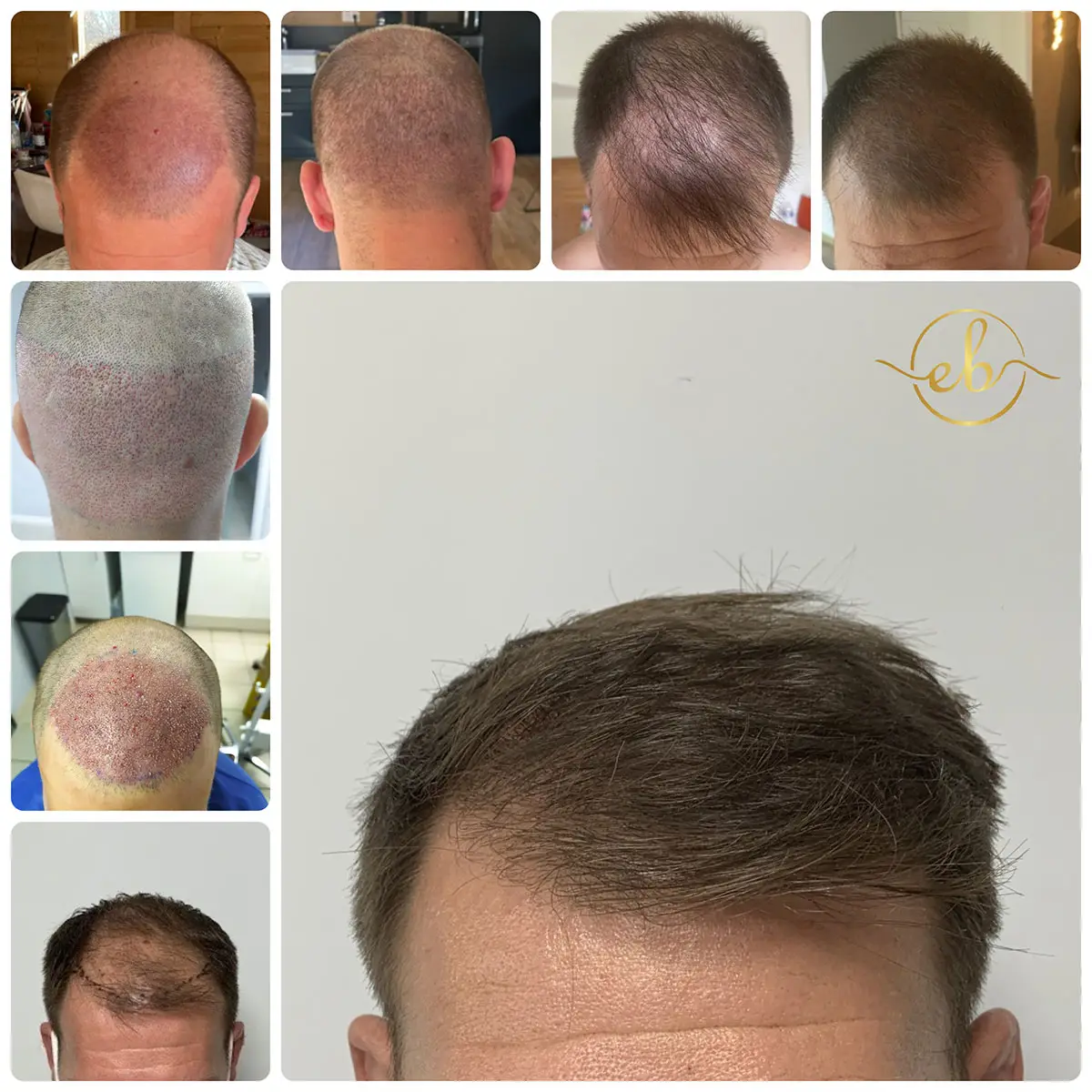
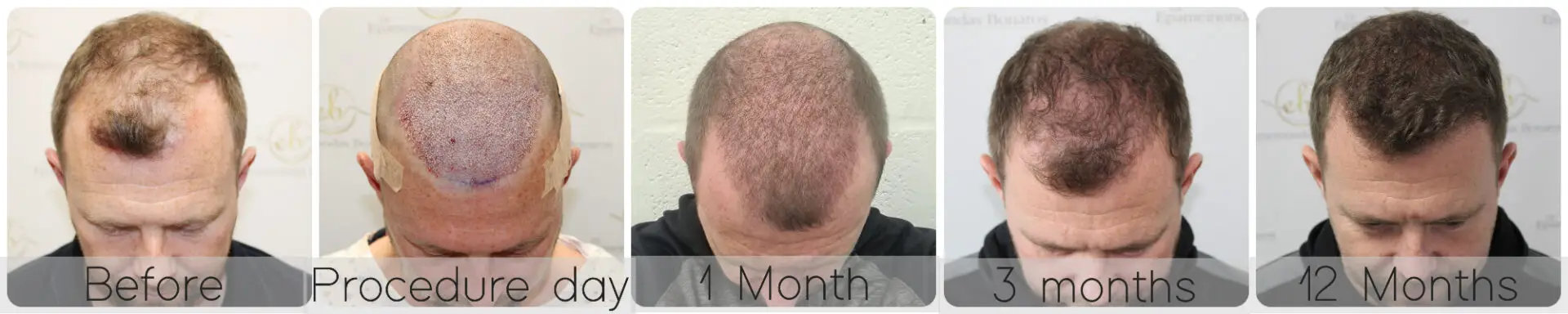
From around month three onwards, the visible transformation begins. This is the stage patients look forward to most.
Months 3–4
About 3 months after your hair transplant, you should start to grow hair that is very fine, transparent, short, and wispy. This will eventually normalise.
At this point, it is also normal for some patients to see what appears to be an imbalance in the areas of regrowth. As regrowth continues, the distribution of hair will soon appear more even. For example, hair may appear fuller on one side of the head than the other. It is important to remember that hair grows at different rates for each individual, and hair does not all grow at the same time.
At any given moment, hairs may be growing, resting, or shedding, depending on where they are in the hair growth cycle. You should remain patient and avoid worrying about any patchiness.
Dr Bonaros will hold check-up appointments in the third month to evaluate and take photos of your progress. The hair transplant healing process is different for everyone, and frequent follow-ups allow us to ensure there is nothing unusual about your recovery. They also give you a chance to discuss any questions you may have about the aftercare process and the future of your hair.
Months 5–9
Five months after your hair transplant, you should notice a considerable amount of hair growth. This hair will still be thin, but from now on it will become thicker and exhibit textural changes.
After 6 months, approximately 60% to 70% of new hair has fully penetrated the scalp, and the result is around 40% to 50% mature. The maturation process refers to the darkening, thickening and normalising of your hair. At this stage of the recovery process, Dr Bonaros will organise another follow-up to see how you are doing.
6 months
The six-month mark represents the halfway point of your total hair transplant recovery time. By this stage of recovery, most patients are satisfied and have begun to see actual cosmetic results.
Your transplanted and native (existing) hair should blend together seamlessly. This new, fuller head of hair is easily styled and cut according to your preferences.
Over the next 6 months, your new hair will grow even more, and the hair that was already present will mature and thicken. The donor area should be nearly completely healed by this point.
12 months
Typically, your new hair is fully grown and mature a year after your transplant procedure. Dr Bonaros will schedule a follow-up appointment to examine the overall outcome and discuss any questions you may have. Hair transplant surgery can give you a hairline that looks completely natural and is virtually undetectable.
It’s important to remember that this hair transplant timeline is just a rough guideline. For some transplant recipients, it may take longer for hair to emerge and mature in density and thickness. This is especially true for patients who undergo mid-scalp or crown hair transplants. These areas grow and mature more slowly than those in the front, and it may take a full 18 months to see final results.
If you find your recovery to be ahead of or behind the curve, it does not mean your overall hair growth and coverage result will be better or worse. It just means your FUE recovery timeline is unique to your situation.
Help ensure the success of your hair transplant recovery with expert advice from Dr Bonaros. Feel free to contact us at any stage of your recovery with any questions you may have.
WhatsApp us