
A quote of 2,000 grafts doesn’t tell you much on its own. What matters is how much of your scalp those grafts can cover, and few clinics work that out for you. We’ve done the sums below, and Dr Bonaros can check them against your own scalp at your consultation.
Key takeaways
- 2,000 grafts hold around 4,600 hairs on average, though it can be anywhere from about 3,300 to 5,500.
- Placed at 30 to 45 grafts per cm², they cover about 45 to 65 cm². That’s roughly the size of a credit card to a playing card.
- They won’t cover a large bald area at natural density. They also won’t stop the surrounding hair from thinning.
- Full results take 10 to 18 months, so check how long after surgery any photo was taken.
- Ask any clinic how much area its graft count will cover, not just the number.
How many hairs are in 2,000 grafts?
On average, 2,000 grafts hold around 4,600 hairs, though it can range from roughly 3,300 to 5,500 hairs.
A graft is a natural cluster of 1 to 4 hairs, according to the NHS. One study of ten men measured an average of 2.3 hairs per extracted graft, with an individual range between 1.65 and 2.75. Multiply these figures by 2,000 to get the numbers above. The study is small, so treat it as a guide, not a promise.
How much area do 2,000 grafts cover?
At 30 to 45 grafts per cm², 2,000 grafts cover about 45 to 65 cm². The sum is area = grafts ÷ density. For scale, a credit card is about 46 cm² and a playing card about 57 cm².
- At 30 grafts per cm², 2,000 grafts cover 67 cm².
- At 35 grafts per cm², they cover 57 cm².
- At 40 grafts per cm², they cover 50 cm².
- At 45 grafts per cm², they cover 44 cm².
A higher density looks fuller but covers a smaller area. A lower density covers a larger area but looks thinner. Your surgeon will choose based on your face, your hair and your predicted future loss.
Natural density is higher than these numbers. The donor areas in the study above had about 155 hairs per cm², which, at 2.3 hairs per graft, is roughly 65 to 70 grafts per cm². A transplant usually restores less than that.
To estimate your own area:
- Measure the width and depth of the area in centimetres and multiply the numbers. An area 10 cm wide and 5 cm deep is 50 cm².
- Divide 2,000 by that area. In this example, 2,000 ÷ 50 = 40 grafts per cm².
- If your result is close to 20, 2,000 grafts are unlikely to be enough.
The scalp is curved, so this is a rough estimate. Photos sent through our online assessment form provide a better starting point, and an examination gives more accurate answers.
Who is a 2,000-graft transplant right for?
A 2,000-graft transplant usually suits people with early-to-moderate hair loss. That might be a receding hairline, thinning temples or a thin frontal zone, with the crown still largely intact. Doctors grade hair loss on the Norwood scale, from 1 to 7. Around 2,000 grafts may suit the middle stages, though the right number always depends on the person.
A few things matter more than the stage:
- Your pattern of loss is stable. The NHS says a transplant suits permanent, inherited baldness and is usually not suitable for types such as alopecia areata.
- You have enough donor hair at the back and sides.
- You’re planning for the next ten years, not just today.
Our page on hairline transplants goes into more detail. The crown is a larger, curved area and is planned differently.
What 2,000 grafts can't do
They can’t cover a large bald area at natural density, and they won’t stop the surrounding hair from thinning.
It’s simple maths. If you spread 2,000 grafts over 100 cm², you get 20 grafts per cm². That’s around a third of natural density and tends to look sparse, which is why surgeons usually treat extensive loss in stages.
A transplant moves hair; it doesn’t change the cause of your hair loss. The NHS notes that hair may keep thinning around the transplanted area. Ask your surgeon how the design will look if your loss continues, and what medical options exist alongside surgery.
If 2,000 grafts aren’t enough for your whole plan, agree the order of work first: usually the front, followed by a review once the result has matured.
Should you plan for 1,500, 2,000 or 3,000 grafts?
The right number is one that matches your plan. This doesn’t necessarily mean the largest amount. Over a 50 cm² area, 1,500 grafts give 30 per cm², 2,000 give 40 and 3,000 give 60, which is closest to natural density.
The extra 500 grafts between 1,500 and 2,000 add 10 grafts per cm² in that area. More grafts also means more taken from a finite donor area. If a surgeon suggests fewer than you hoped for, they may be protecting the donor area for future treatment.
What happens to your donor area?
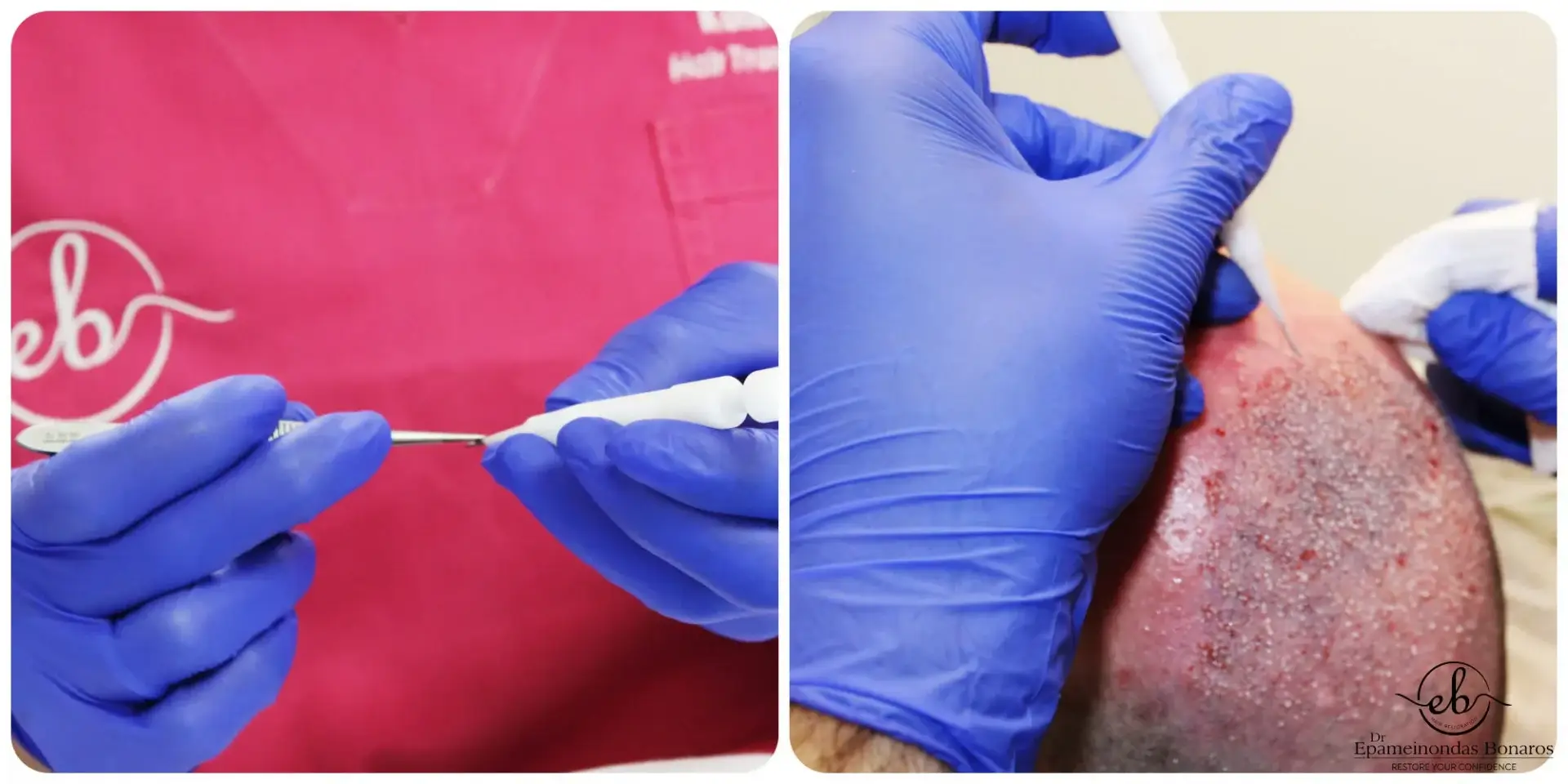
With follicular unit extraction (FUE), follicles are taken one at a time from the back of the head, leaving many tiny scars. The NHS says these are usually not very noticeable.
The same small study of ten men removed an average of 35% of hairs from 1 cm² test areas. Its authors suggested keeping the first session under 35% of total density and the second session between 10% and 20%. They warned that a donor area left between 20% and 30% of its original density would look odd. That’s just one opinion from a small group, not a rule. Ask any clinic how they decide how much to take.
Are you experiencing noticeable thinning hair or hair loss?
Book a consultation with Dr Bonaros for a comprehensive assessment and tailored treatment plan.
What to expect after surgery
It can take between 10 and 18 months to see the full results. The hair you see in the first weeks won’t last. The NHS gives this timeline:
- Days 0 to 14: the grafts aren’t yet secure. Time off work is usually 1 to 2 weeks.
- Days 2 to 5: bandages can usually come off, but you must not touch the grafts.
- A few weeks: transplanted hair often falls out.
- About 4 months: new hair usually begins to appear.
Waiting for months can feel difficult. Between the initial shedding and new hair growth, the area can look worse, not better. Shedding worries many people because it looks like the work has been undone, but it’s normal.
Our FUE hair transplant timeline goes through it stage by stage. Side effects can include a tight, swollen scalp and scabbing. There’s also a small risk of bleeding, infection, a noticeable scar or grafts that don’t take.
How do you read before and after photos?
Photos can be misleading. Some points to check before you trust a clinic’s before-and-after photos:
- Time since surgery. A photo taken at 3 months doesn’t show the final result.
- Hair length. Long hair hides density, while short hair shows it.
- Lighting, angle and wet or dry hair. These should be the same in both photos.
- The graft count and the area. A number without the area’s size means very little.
Photos help you judge how a clinic works, but they can’t predict your own results. Our gallery and case studies show real results, including procedures with 2,003 grafts and 2,016 grafts. Use the checks above when you study them.
What should a fair quote include?
It should tell you exactly what you’re paying for, not just the total price. The NHS puts UK costs between £1,000 and £30,000, depending on hair loss, treatment method and the quality of the clinic and team. Those figures aren’t very helpful for planning your expected costs, so ask what’s behind any quote:
- Is the graft count an estimate, and what happens if fewer are placed?
- Is the price fixed, or per graft?
- Who performs each stage: the surgeon or a technician?
- Which follow-up appointments are included, and where will they be?
The NHS also suggests checking that the surgeon is on the General Medical Council (GMC) register with a licence to practise, and whether they’re a member of the British Association of Hair Restoration Surgery (BAHRS). In England, check the clinic’s Care Quality Commission (CQC) registration. In Scotland, Healthcare Improvement Scotland regulates independent clinics. Ask how many transplants the surgeon has done and how many had complications.
These questions apply in the UK or abroad. The practical difference with travelling abroad is follow-up. If you have a problem in week two, how far away is the person who did your surgery? Our cost guide covers our own pricing.
Getting a number for your own head
Whether 2,000 grafts is the right number depends on your own hairline, pattern of loss and available donor area. The sums in this article can only tell you so much. An examination is the only way to know how many grafts your plan needs and what area they’ll cover. Send photos through our online assessment form or contact us to book a 45-minute consultation with Dr Bonaros for an in-depth check of your condition.
FAQ
Frequently asked questions
Is 2,000 grafts enough for a receding hairline?
How long does the procedure take?
The NHS says most procedures take one day, and you usually don’t need to stay overnight. The exact time depends on your plan, including how many grafts are placed and which areas are treated. You’ll be told what to expect during your consultation. Time off work afterwards is usually 1 to 2 weeks, so plan for that before you book.
When will I see the results?
According to the NHS, new hair usually starts to appear at about 4 months. Before then, the transplanted hair often falls out within a few weeks, which is expected. Full results take 10 to 18 months, so a photo taken at 3 or 6 months won’t show the final result.
Can women have a 2,000-graft transplant?
Some can, depending on the pattern of thinning. Hair loss in women can look different from men’s, so the right plan depends on where and how the hair is thinning. An examination is needed to see whether a transplant is right for you. See our page on hair transplants for women.