Hair Transplant Cost in Glasgow Scotland
The cost of a hair transplant in Glasgow is an essential consideration for anyone seeking hair replacement options in and around Scotland.
Grey hair can be successfully used in hair transplants. At the Dr Bonaros Hair Transplant Clinic, this procedure is standard among both older patients and younger individuals experiencing premature greying.
Can grey hair be transplanted? Read on about common misconceptions and what’s really possible with grey hair transplant procedures.
Reviewed by Dr Epameinondas Bonaros
The International Society of Hair Restoration Surgery (ISHRS) has confirmed that the colour of your hair, including grey, doesn’t affect the safety or outcome of a hair transplant.
The Misconception about Grey Hair: Greying doesn’t necessarily mean you don’t have healthy hair or that your hair growth has slowed. In fact, white hair has been noted to stay in an active growth phase.
A study published in the British Journal of Dermatology found that white (grey) hair is linked to more active growth genes than black (pigmented) hair. Proteins that build and support hair were higher in white hair follicles, while some growth signals switched up or down.
Grey hair can also be slightly thicker, which can help create a natural-looking density in a transplant. The thicker strands of donor hair can also be easier to harvest from the scalp.
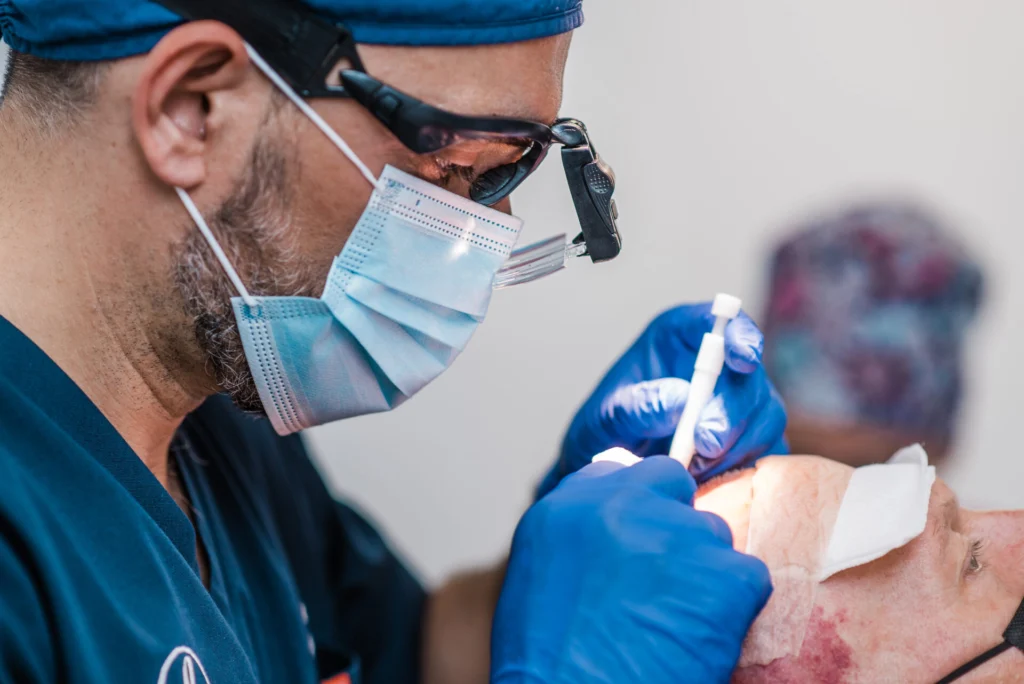
We use the Follicular Unit Extraction (FUE) method for grey hair transplantations. Our FUE hair transplant surgery is led by Dr Bonaros, an expert hair transplant surgeon, from start to finish.
During your in-person or online appointment, we will assess whether you are a suitable candidate for a hair transplant. We will review your medical history, examine your entire scalp condition and discuss your expectations.
The steps of FUE hair transplant surgery:
Preparation: The donor area (usually the back or sides of the head) is cleaned and numbed with local anaesthesia.
Extraction: Individual hair follicles are carefully removed from the donor area using a specialised WAW Duo FUE system.
Transplantation: The extracted follicles are carefully implanted into the recipient sites for natural-looking coverage.
Here is why you can expect satisfying results from our technique for grey hair transplants
Minimal scarring: Leaves nearly invisible scars, allowing you to wear your hair short.
Quicker recovery: The procedure is less invasive, so healing is faster
Safe for all hair types: Works effectively for grey or white hair as well as pigmented blond, brown, red or black hair.
Natural results: Individual follicle placement ensures a natural appearance that blends with existing hair.
Hair gets its colour from melanin, produced by specialised cells called melanocytes in the hair follicle. Melanocyte stem cells (McSCs) help replace pigment cells. Grey hair occurs when pigment cells stop functioning properly.
Loss or dysfunction of pigment cells: When melanocytes die or produce less melanin.
Ageing stem cells: Over time, some McSCs stop producing new pigment cells, making greying permanent.
Hair growth cycle: Pigment is only made during the growth phase (anagen). Most pigment cells die during the resting phase (catagen).
Supporting cells matter: Epithelial stem cells in the follicle play a crucial role in helping melanocytes function. Any issues here can contribute to early greying.
The root cause of greying hair: Hair greying is mainly caused by pigment cells losing function, combined with age-related changes in stem cells that replenish them.
Premature greying of hair can happen for several reasons, often linked to lifestyle, genetics and environmental factors.
A 2012 global survey highlighted how common grey hair is and how it varies among people:
Gain expert insights on hair loss and thinning in our free resource library.
No. Transplanted hair comes from your own follicles and keeps its original colour, so a transplant cannot remove grey hair.
Yes. Once your scalp has fully healed, it is safe to dye your hair, including transplanted grey hair grafts.
The quick answer is yes. Transplanted grey follicles produce new hair in the same colour they were extracted in.
The texture and growth cycle remain consistent. Even in those who turn grey early or at a young age, the transplanted follicles continue to grow healthy strands of hair.
Yes, during the planning stage, surgeons can design a natural hairline in a new location that complements your facial features and age.
Not necessarily. The number of grafts depends on the size of the balding area and the desired density. Some patients may need fewer grafts if their balding area is small, while others require more extensive coverage.
Many patients also find that their hair begins to thin or turn grey early due to genetics or other factors, which can influence the number of grafts ultimately required.
Get in touch with our hair loss clinic for more information about our restoration options for grey hair.
Greying can appear at any age, from a subtle salt-and-pepper to a bold streak of white. That’s why we create a personalised plan for every patient.
At Dr Bonaros Hair Transplant Clinic in Glasgow, we offer a range of hair restoration treatments.
Dr Bonaros is a highly respected hair transplant surgeon with the following affiliations:
Reclaim a fuller head of hair and your self-confidence. Schedule your appointment (face to face or online options available) with Dr Bonaros to explore grey hair transplant options.

The cost of a hair transplant in Glasgow is an essential consideration for anyone seeking hair replacement options in and around Scotland.

Retrograde Alopecia — Causes, Symptoms & Treatments If you have noticed hair thinning at the nape of your neck or above your ears, you might be affected by retrograde alopecia. This unique form of hair loss affects many individuals — yet often goes unrecognised. While studies into retrograde alopecia causes

Can Women Have Hair Transplants? Hair loss can be a distressing experience; no gender is spared. However, while hair transplantation is commonly associated with male pattern baldness and receding hairlines, women also take great care to consider hair restoration treatments. So, can women have hair transplants? Read further as we

How to Choose a Hair Transplant Clinic When researching how to choose a hair transplant clinic, it’s always best to focus on facilities with a well-established reputation, clear communication, and a patient-first approach. These factors are crucial for ensuring a successful restoration experience. If you’re keen to learn more about

Dr Bonaros is committed to providing the best possible guidance and care for patients suffering from hair loss.

Low-dose oral minoxidil can be an alternative to topical minoxidil in the treatment of hair loss.