

Key takeaways
- The scale describes the pattern of hair loss, not how fast you will lose it.
- Stages 1 and 2 usually sit within the normal range. Most clinicians consider stage 3 the first clinically significant stage.
- Your best treatment option depends on your stage, age, and how settled the pattern is. Your donor hair is also considered.
- Medication only works while you use it. Surgery moves hair, but doesn’t create it. Donor supply will set the limit.
- A chart can point you to a stage. Only an examination shows what is sensible for you.
What the Norwood scale is, and how to find your stage
The Norwood scale is the standard chart for male pattern hair loss (androgenetic alopecia). The hairline recedes, the crown thins and, in time, the two areas can join. Dr O’Tar Norwood published the version doctors still use today in 1975. See our guide to male pattern hair loss.
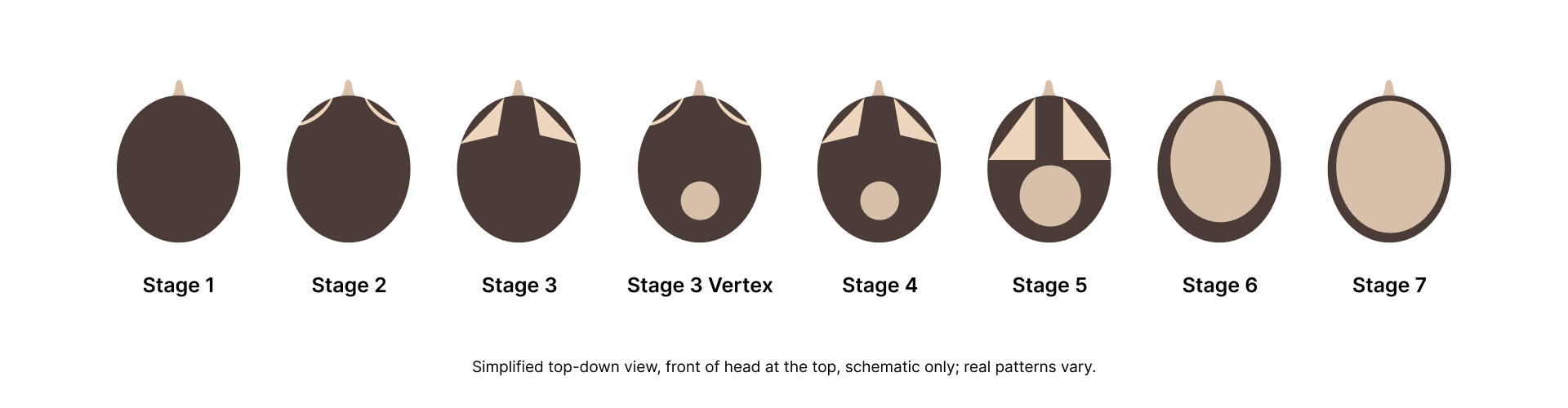
The seven Norwood stages, simplified, seen from above with the front at the top. Real patterns vary.
To find your stage, take photos of your hairline from the front and sides, and your crown from above. Use bright light with dry, combed-back hair. Compare the photos with the stages outlined below, and then repeat three months later. Changes over time tell you more than a single photo. If you’re between two stages, pick the lower one and have a clinician confirm.
The scale only fits male pattern hair loss. Patchy loss, sudden shedding or a sore, scaly scalp usually point to something else, so see a General Practitioner (GP).
Norwood stages 1 to 7: what people usually consider
These are not treatment recommendations. Your options will depend on your age, family history, how fast your hair has changed and your donor hair.
Stage 1: no visible loss
Looks like: a full hairline. Usually considered: nothing needs treating. Men with a family history of pattern hair loss may want to take baseline photos.
Stage 2: slight recession at the temples
Looks like: a soft, symmetrical triangle of recession at the temples. Normal or early loss? Most hairlines settle a little higher in the late teens and twenties, then they stop. This mature hairline looks like stage 2 and is not baldness. Recession that keeps moving and involves finer hair is different. Our guide to a natural-looking hairline shows how. Usually considered: monitoring with photos every 6 to 12 months. Surgery is rarely the first step.
Stage 3: the first clinically significant stage
Looks like: bare or thinly covered temples; a deep M-, U-, or V-shape. Usually considered: medication to slow further loss. If the pattern seems to be settling, some people will discuss a hairline transplant. A surgeon will plan with future loss in mind.
Stage 3 vertex: crown thinning first
Looks like: the front hairline stays at stage 1 or 2, but the crown (vertex) thins. Usually considered: medication first. The crown is wide, keeps widening and can use up a lot of donor hair, so surgery is harder. Our crown hair transplant page explains more.
Stages 4 and 5: front and crown both affected
Looks like: more recession, a sparse or bare crown, and a band of hair between them that gets narrower from stage 4 to 5. Usually considered: medication and surgery are both realistic. Donor supply becomes important now, so surgery focuses on the area that matters most to you.
Stage 6: the bridge disappears
Looks like: front and crown merge into one large bald area. Usually considered: medication is less effective where follicles have disappeared. Donor supply limits surgery, so surgeons often talk about framing the face. One stage 6 case study used 4,012 grafts. This was one patient’s plan and not a guide for others. Some men choose a close crop, scalp micropigmentation or a hair system at stage 6.
Stage 7: the horseshoe
Looks like: only a narrow, possibly fine, band of hair around the sides and back. Usually considered: surgery is often unsuitable at this stage. Cropping, camouflage and a frank talk with a surgeon are the usual options.
What causes the Norwood pattern?
It comes down to inherited sensitivity to DHT (dihydrotestosterone), a by-product of testosterone. Sensitive follicles at the temples and crown shrink over successive hair cycles, so hair grows back finer and shorter. Then it stops altogether. Follicles at the back and sides are less sensitive, so they usually keep growing hair. See the biology of hair loss.
It often runs in families. A 2017 UK Biobank study of more than 52,000 men found hundreds of genetic regions linked to severe hair loss, including regions on the X chromosome and other chromosomes. The British Association of Dermatologists (BAD) describes a mixture of genetic and hormonal factors.
Other causes look different: sudden shedding after illness or stress, patchy loss, a sore or scaly scalp, low iron, thyroid problems, certain medicines, or even thinning across the whole scalp (diffuse unpatterned alopecia). Many of these are treatable, so get unexplained thinning checked. See other causes of hair loss.
Will my hair loss get worse?
It usually progresses, and it runs in families, but nobody can say how far or how fast. Some men stay at stage 2 or 3 for years. Others move through several stages quickly, and the BAD notes that earlier onset may mean quicker progression. Take baseline photos now, repeat them every three months, and act on change, not fear.
Medication or surgery?
Medication aims to help you keep the hair you have. Surgery moves hair from where it is permanent to where you have lost it. They do different jobs, so surgeons often discuss both together.
Medication works on living follicles, so it’s best suited for early hair loss and thinning. It cannot restore hair on smooth, bald skin, and it only works as long as you keep using it.
Surgery does not stop the rest of your hair from thinning, so you often continue medication alongside it. It is not offered on the NHS. Our cost guide explains what affects the price.
Medication alone is often a sensible start, especially at stages 1 to 3, or when hair is thinning rather than gone. It is worth discussing surgery when the pattern has settled, you have enough healthy donor hair, and you keep your expectations realistic. Dr Bonaros generally advises patients under 25 to stay on medical treatment for two to three years first. See who is a good candidate.
Are you experiencing noticeable thinning hair or hair loss?
Book a consultation with Dr Bonaros for a comprehensive assessment and tailored treatment plan.
The common medicines
The NHS names two main treatments, minoxidil and finasteride. Neither one works for everyone. They only work while you’re using them, and neither is 100% effective. Discuss any medicine with a prescriber. Our hair loss medication guide has more details. Light devices and PRP injections are also marketed, but they aren’t among the NHS’s main treatments, and results vary.
Minoxidil is a lotion or foam for the scalp. You can buy it without a prescription, and it’s not usually available on the NHS. The BAD says the 5% strength needs at least 6 months, possibly 12, before you can judge any benefit. Some people shed more early on, and benefit fades if you stop. See minoxidil for men.
Finasteride lowers the hormone that shrinks follicles. In the UK, it’s prescription-only, and the NHS says women should not use it. The BAD says it can take up to 14 months of continuous use to see benefit. The MHRA has asked men taking it to stay vigilant for mental health and sexual side effects, including depressed mood and suicidal thoughts. Sexual problems have continued after stopping for some men. Tell your prescriber about any history of depression before taking it. If your mood drops, stop and contact your doctor as soon as possible. Samaritans are available on 116 123.
See your GP promptly if hair loss is sudden, patchy or in clumps, or if your scalp is sore, itchy or scaly. This also applies if you have other symptoms such as tiredness or low mood, or you are a woman or under 18. The NHS advises seeing a GP before a commercial hair clinic.
Your stage and donor supply
A transplant moves hair from the back and sides of your scalp (the donor area) to where you’ve lost hair. Donor hair resists the hormone behind pattern loss, so it tends to last. The supply is fixed, so the further along you are, the more area you have to cover with the same limited hair.
Surgeons therefore prioritise. They often prioritise the hairline and front, and plan for the stage they predict you’ll reach. Dr Bonaros designs a hairline which continues to look natural as you age. Follicular unit extraction (FUE) takes follicles one by one, while the older strip method (FUT) takes a narrow strip of skin and leaves a linear scar. Read about our FUE hair transplant or compare the methods.
No honest article can give a graft number for your stage. It depends on donor density, hair characteristics and the area to cover. Only an examination can determine this. Our hair transplant for men page explains more.
Does the Norwood scale apply to women?
No. Women usually thin across the top rather than the front. Doctors use the Ludwig scale for women. See our guide to female pattern hair loss.
Looking after yourself
Hair loss can significantly affect your confidence. It doesn’t bother some men, but if you are struggling with the psychological impact of hair loss, tell your GP. Our article on how hair loss affects you psychologically may help. There is no rush at stages 1 to 3. It’s important to look after your mental health as well as your hair.
When to book a consultation
Consider booking a consultation when your hairline or crown is clearly changing, you’re unsure which stage you’re at, or you want an honest view on medication or surgery. Dr Bonaros’s consultation is a paid appointment of about 45 minutes. You can do it in his Glasgow clinic or online. He examines your scalp and history, explains what’s realistically achievable, and goes through costs. There’s no obligation to be treated. Not ready? Try our online assessment form.
FAQ
Frequently asked questions
What is the Norwood scale?
A seven-stage scale of the usual patterns of male pattern hair loss. It runs from no visible loss at stage 1 to a band of hair around the sides and back at stage 7. It only assesses where hair has been lost, not how fast it will progress.
What stage of baldness am I?
Photograph your hairline and crown in the same light with dry hair, then compare them with the stage descriptions. A clinician can confirm your stage if you’re unsure.
Is Norwood 2 normal?
Slight temple recession is common as the hairline matures in the late teens and twenties. If it keeps receding over a year or two, or if hair loss runs in your family, see a GP or specialist.
Which Norwood stage is best for a hair transplant?
There is no right answer here. Surgeons look for a settled pattern and enough healthy donor hair. They also need to manage your expectations about what’s realistically achievable. Stages 3 to 5 are most often discussed, but suitability depends on the individual.
Can you have a hair transplant at Norwood 6 or 7?
Sometimes, but donor supply is usually limited. The aim is usually to frame the face and improve key areas. Some people are not suitable. An examination can evaluate how realistic a hair transplant is for you.