


Key takeaways
- A hairline that settles slightly higher in your late teens or twenties is normal. If it keeps moving back, with deepening temples and finer hairs, it’s usually male pattern hair loss.
- Dated photos every three months show how it progresses.
- Minoxidil and finasteride can slow hair loss, but only for as long as you keep using them.
- In May 2026, the MHRA strengthened its warnings about finasteride. Read that section before you decide on treatment.
- See a GP first if the hair loss is patchy, sudden, itchy or scarred.
- Surgery is a long-term design decision. Younger men are usually advised to wait.
Is your hairline receding or just maturing?
Almost every man’s hairline moves. Between the late teens and early thirties, it usually settles about an inch higher, with slight temple recession. That is a mature hairline, not hair loss. A receding hairline keeps going. Four differences to note are:
- Movement. A mature hairline moves once, then holds. A receding one keeps moving back.
- Shape. A mature line stays a soft curve. Recession carves a deeper M, U or V shape.
- Hair quality. Near a receding line, hairs become thin, short, and pale. This is called miniaturisation.
- Density. The scalp starts to show through the front, especially when hair is wet.
No single sign proves anything. A 22-year-old whose hairline hasn’t changed in two years is likely maturing. A 28-year-old whose temples have deepened since 25 should take it seriously. Our guide to what makes a hairline look natural shows what a well-designed mature line looks like.
How to check your hairline yourself
- Take dated photos. Same room, daylight, dry hair combed back, camera at eye level. Shoot front and sides every three months.
- Do the finger test. Rest your fingers flat above your eyebrows and count how many fit before your hairline. Record the number each time.
- Compare front and back. Finer, shorter or paler hairs at the temples than at the back suggest miniaturisation.
- Ask about family. Pattern hair loss can come from either side. It raises the odds but doesn’t guarantee it.
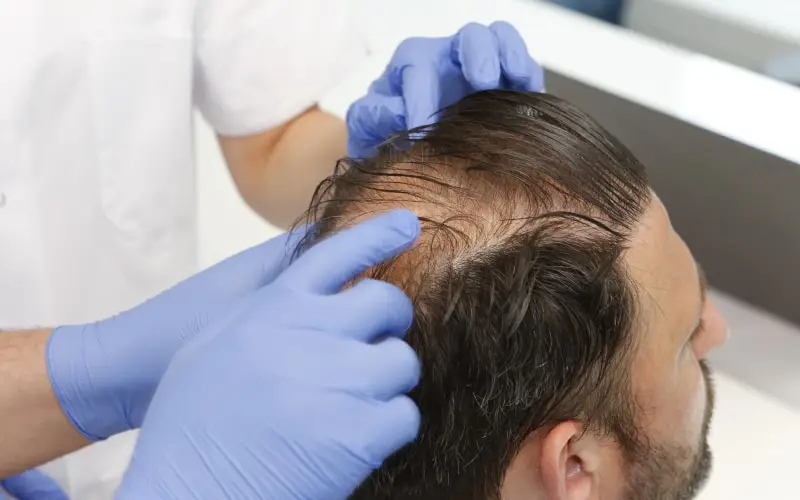
A clinician will ask what medicines you take. Then they’ll examine your scalp, often with a dermatoscope. This handheld microscope shows miniaturised hairs and early scarring. Blood tests are added if needed.
The stages of a receding hairline
Doctors use the Norwood scale. It has seven stages, but you won’t necessarily reach each one.
- Stage 2. Slight temple recession. This can be a mature hairline and is often normal.
- Stage 3. Deeper recession at both temples. This is the first stage generally considered clinically significant.
- Stage 4. More recession, a thinning crown and a band of hair between them.
- Stages 5 to 7. The band narrows and disappears, leaving a horseshoe of hair at the sides and back.
Knowing your stage helps you understand your treatment options, but nothing is set in stone.
Why hairlines recede
The most usual cause is male pattern hair loss, which the British Association of Dermatologists calls the most common type of hair loss in men. Follicles at the temples and crown can be genetically sensitive to dihydrotestosterone (DHT), a hormone made from testosterone. Over repeated hair cycles, sensitive follicles shrink, and each new hair comes in thinner and paler until none is visible. Many genes from either parent are often involved.
Follicles at the back and sides can resist DHT, which is why they serve as donor hair in a transplant. Stress and illness can cause a temporary heavy shed, but that is general thinning, not recession.
When it is not simple pattern loss
Some scalp conditions scar the follicle, and scarred follicles do not recover. Early diagnosis can be important for successful treatment.
- Frontal fibrosing alopecia. The hairline retreats in a smooth band, often with eyebrow loss. The skin may appear pale and shiny.
- Traction. Tight braids, man buns or headwear can pull on the edges. If caught early, it can recover. See traction alopecia.
- Alopecia areata. An autoimmune condition that usually causes smooth, round patches.
- Medicines and hormones. Anabolic steroids and testosterone can speed up pattern loss. Our guide to non-AGA causes of hair loss has more information.
See a GP or dermatologist first if
- Hair is falling out in patches, or it starts suddenly.
- Your scalp is red, itchy, scaly, sore or burning.
- The skin along your hairline looks smooth and shiny.
- Your eyebrows are also thinning.
- You started a new medicine, steroid or hormone treatment.
- You are under 20, and your hairline is moving quickly.
The NHS advises seeing a GP before going to a commercial hair clinic. Creatine is a common worry, but there is no good evidence that it causes hair loss: see creatine and hair loss. For women, see female pattern hair loss.
Can a receding hairline grow back?
Pattern hair loss is progressive and has no cure. Cosmetic and medicine-based treatments can help.
- Slow or stop it. Medication can reduce or halt further loss in many men.
- Some regrowth. Thicker hair growth is possible when follicles are shrinking but still alive. The crown usually responds better than the temples.
- Replace lost hair. When follicles are gone, only surgery can add hair.
Medication works for as long as you use it. If you stop, you usually lose any hair you kept over the following months.
Treatments with evidence behind them
Two different medicines have the strongest evidence. Neither of them is a cure. They both work slowly, and long-term success depends on staying on the medicine.
- Minoxidil. A lotion or foam, usually 5% strength for men and sold over the counter. The BAD patient leaflet says it may take six to twelve months to judge, and extra shedding in the first weeks is common.
- Finasteride 1 mg. A daily prescription tablet that lowers DHT. It is licensed in the UK for male pattern hair loss and is generally the most effective medicine for slowing the pattern.
- Dutasteride. Licensed for prostate enlargement, so use for hair is off-label. The BAD says results are not convincingly better than finasteride and side effects are more frequent.
- Laser, microneedling and PRP. The BAD describes the evidence as limited or unclear.
- Camouflage. Short haircuts, hair fibres and scalp micropigmentation can disguise recession without treating it. Caffeine shampoos aren’t a treatment for a genetic pattern.
Finasteride and what the MHRA says
On 11 May 2026, the MHRA strengthened the safety warnings on finasteride 1 mg. The product information now says sexual dysfunction may contribute to mood disorders, and it has been reported with and without mood changes. The MHRA added a precautionary warning for dutasteride 0.5 mg. Patient alert cards, introduced in 2024, remain in place.
Most men will not have a problem. The BAD puts reduced libido or erection problems at about 2% of users. But low is not zero, so:
- Read the leaflet and alert card before you start.
- If you develop low mood or thoughts of self-harm, stop finasteride and get medical advice promptly. In an emergency, call 999, or 111 for urgent advice. Samaritans are available on 116 123.
- Tell your prescriber about sexual side effects, and report suspected side effects through the Yellow Card scheme.
You and your prescriber, who knows your history, make the decision. Our hair loss medication guide covers the options.
Medication first or surgery first?
There is no universal rule. A good clinician will ask:
- How old are you, and how fast is it moving? Younger men whose loss is not settled are usually advised to start medication first, before considering a transplant.
- What stage are you at? Early recession often suits medication. Large areas of established loss are where surgery is considered.
- Will you stay on medication? Surgery does not help existing hair behind the new hairline.
For many men, medication protects existing hair, and surgery restores what’s been lost.
Hair transplant for a receding hairline
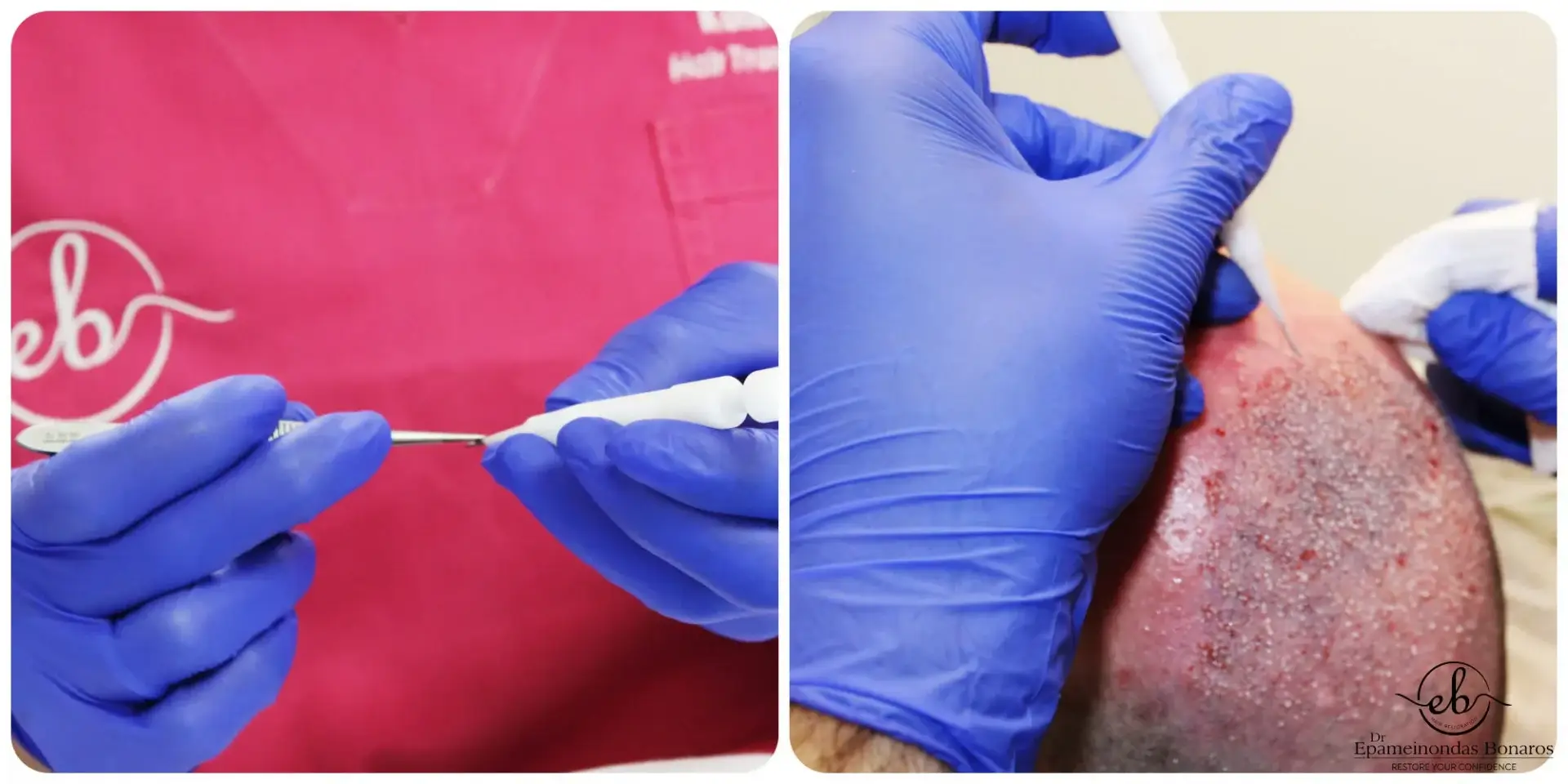
A transplant moves follicles from the back and sides to the front. The back and sides are more resistant to DHT. Transplanted hair can keep growing for decades, although results vary. In the UK, a transplant is only available as a private procedure. Our hairline transplant page explains the procedure, and “Are hair transplants permanent?” covers longevity.
Design is usually more important than graft count. The front edge should be soft and uneven, built from single-hair grafts. You can lower a hairline later, but raising one placed too low is difficult.
At this clinic, most hairline and temple plans use 800 to 1,800 grafts, and grafts typically cost around £4 per graft. See our blog on hair transplant cost in Glasgow. Trust the figure in your written quote. Our case study on rebuilding a receding hairline shows a real patient case study.
Are you experiencing noticeable thinning hair or hair loss?
Book a consultation with Dr Bonaros for a comprehensive assessment and tailored treatment plan.
A receding hairline in your teens and twenties
Most of the time, noticing early changes does not mean pattern hair loss. It’s normal maturation. Photos can tell the two apart. If your hairline is moving fast or you are under 20 and clearly thinning, see a GP rather than buying treatment online. Surgeons advise younger men to wait. The right hairline at 22 might be the wrong one at 52. If it is affecting your mood, read how hair loss affects you psychologically.
Getting help in the UK and choosing a surgeon
- GP. Rules out other causes, tests thyroid and iron levels, and refers you to a dermatologist. Many treatments are not available on the NHS.
- Pharmacist. Sells minoxidil. Finasteride needs a prescription.
- Regulated online prescriber. Check that the pharmacy is registered with the General Pharmaceutical Council and that a prescriber reviews your history.
- Private clinic. The route to surgery. Independent clinics are regulated by Healthcare Improvement Scotland in Scotland and the Care Quality Commission in England.
Checks before you book surgery
- Look the surgeon up on the GMC register.
- Ask who performs each stage: design, extraction, incisions and placement.
- Ask to see 12-month results for cases similar to yours.
- Be wary of fixed packages abroad before anyone has examined you: see medical tourism and black-market clinics.
Our guide to choosing a reputable hair transplant surgeon in the UK goes further.
Your next step
For a professional opinion, send us photos through our online assessment form or book a consultation with Dr Bonaros. You will meet the surgeon, not a salesperson. A consultation takes about 45 minutes, with no obligation to book. This article is general information and does not replace an examination.
FAQ
Frequently asked questions
At what age does a hairline start to recede?
A mature hairline usually settles between the late teens and early thirties. Male pattern hair loss can start at any adult age. Whether your hairline keeps moving is more important than your age.
How do I know if my hairline is receding or mature?
A mature hairline moves once, settles by your early thirties, and has normal-thickness hair behind it. A receding one keeps moving and will show finer, shorter hairs. Dated photos every three months can help to judge what is happening.
Can you stop a receding hairline?
There is no cure, but in many cases, treatment can slow down or even stop further loss. Minoxidil and finasteride have the strongest evidence, and both work only as long as you keep using them.
Does a receding hairline mean I will go bald?
Not necessarily. Some men’s recession stops at stage 2 or 3 and stays there. Regular photos can show what is happening.
Does wearing a hat cause a receding hairline?
No. Very tight headwear worn daily can pull on the hairline over years. This is a different condition called traction alopecia.
Can I get treatment for a receding hairline on the NHS?
A GP can check for other causes and refer you to a dermatologist. Not all hair loss treatments are available through the NHS. Hair transplants are private only.
At what age should I consider a hair transplant?
There is no right age. A settled hairline is more important than your age. Fast-moving loss in your early twenties usually means you should wait for a transplant and use medicine first.